In the inter-war years Ammanford produced an outstanding crop of professional boxers, eight of whom went on to become Welsh champions. These eight were either from Ammanford or the nearby area but what they all had in common was that were they trained at the Cross Inn on Ammanford Square by boxing guru Johnny Vaughan. The names of these eight boxers can be found below.
The Amman valley is a small valley compared to the Rhondda, so it can't claim to have produced boxers of world rank such as Freddie Welsh, Percy Jones or Tommy Farr as the Rhondda did. Ammanford, too, is a small town compared to Merthyr, so no world champions like Jimmy Wilde and Howard Winstone or a world contender like Johnny Owen came from here. Nor could we boast two world contenders like Brian Curvis or Colin Jones, as did nearby Swansea. But given the size of our little town, for two generations one man, Johnny Vaughan, could lay claim to being the nearest the Amman Valley produced to legendary boxing manager Eddie Thomas from Merthyr. Johnny Vaughan may have retired from boxing in 1913 but he entered the halls of boxing legend when he took up training and management in 1929 before retiring in 1953. Eight Welsh professional champions in twenty-four years of management is not a bad record at all. He died at his home in Iscennen, Ammanford, in 1964.
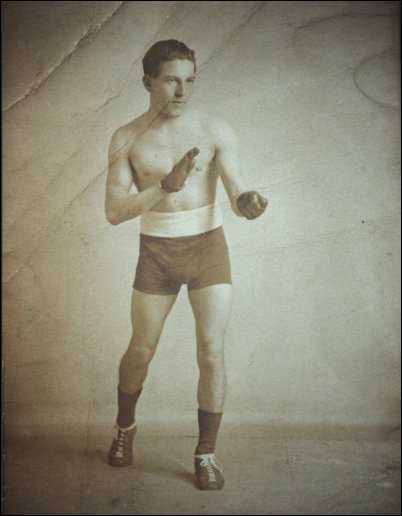
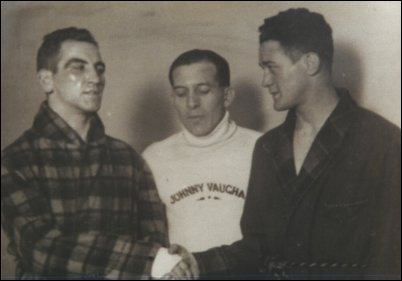
Johnny Vaughan, Welsh Featherweight claimant in 1912 Johnny Vaughan (centre) with Middleweight Danny Evans (left) and South African Middleweight Champion Barney Kieswetter (right) after a fight in 1934 won by Danny Evans. One of Johnny Vaughan's boxers, Danny Evans from Glanamman, went on to become a double Welsh champion, holding the welterweight title between 1932 and 1934, then retiring after he won the middleweight title in 1935. One of the boxer's he beat was South African middleweight champion barney Kieswetter. Barney Kieswetter (above), was a classic example of the professional boxer in the depression years of the 1930s. Kieswetter, a brilliant defensive boxer, was a good-looking young man who used his skills to travel the world, fighting in England, Europe and Australia, forced to literally travel the world in search of fights and a living. Born in Cape Town in 1904 he made his debut as a professional boxer in South Africa in 1929 before moving to London in 1931. In 1932, Kieswetter fought regularly in Wales, where he was a big favourite. He had 26 fights in 1932, with only two losses, one of them by Ammanford's Danny Evans. By 1933 he was looking elsewhere for fights, this time moving to Australia before returning to South Africa in 1934. His last professional fight was in 1939, when war intervened and he served in the South African Medical Corps in East Africa and Europe until 1945. After the war he performed as a magician in theatres and halls throughout South Africa. It was said he was very slick with cards. He died in Pietermaritzberg in 1975. Most professional boxers, with the exception of a lucky few, earn little from their brutal trade. Except for major title fights, the prize money isn't particulary great, and when expenses and the manager's percentage are taken out, little is left for the boxer himself. None of Ammanford's professional boxers were able to make a living as full time boxers during the depression years, and most of them worked in local mines in between bouts.
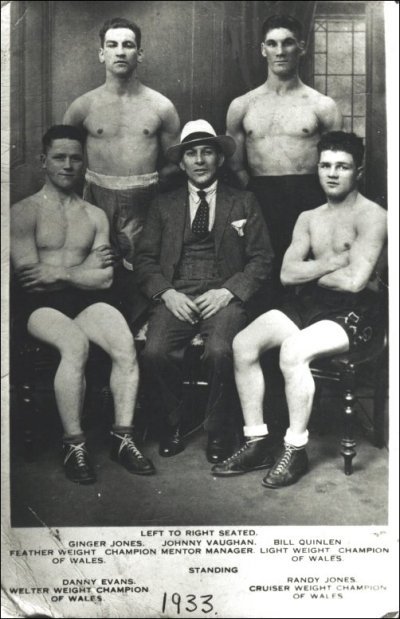
Below is Johnny Vaughan in 1933 with four of his Welsh champions. Billy Quinlen in the picture went on to challenge for the British lightweight title, losing to Harry Mizler at the Vetch Field, Swansea, in 1934.
Four Welsh champions and their manager Johnny Vaughan (seated middle) photographed in 1933. Seated (left to right): Ginger Jones, Featherweight champion (1929-1933); Billy Quinlen, Lightweight champion (1932-1934). Standing (left to right): Danny Evans, Welterweight champion (1932-1934) and Middleweight chamption (1935); Randy Jones, Light-Heavyweight champion (1933)
Awful fate
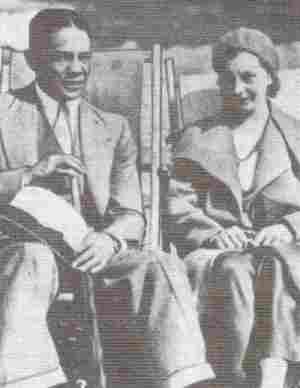
French-Canadian middleweight boxer Del Fontaine and his murder victim, Hilda Meek of Bristol When double Welsh champion Danny Evans (pictured above) beat French-Canadian Del Fontaine, neither of them can have known the awful fate that was in store for the Canadian. Only a few months after his fight with Danny, Fontaine—real name Raymond Henry Bousquet—was hanged for murder! Fontaine's had fallen in love with 21-year-old Hilda Meek, whom he murdered in what was described as a crime of passion. The good-looking Fontaine was found guilty of the crime and sentenced to death. The execution in London aroused great emotion. His friends and fellow boxers pleaded for his life, saying the man suffering from depression (and was also possibly punch-drunk after 98 fights) and was not therefore responsible for his actions. Their efforts failed. The execution in Wandsworth prison created considerable public and media interest. Fontaine wa well-liked in his adopted Bristol and fellow boxers joined the hundreds who gathered outside the prison. Hymns were sung and speeches against capital punishment were made. West Country friends added their names to the long list pleading for a reprieve. The recurring question was: “Should a man suffering from acute depression and one who was probably punch-drunk have been condemned to death?" It was true that he was on the slide. After landing in England off a cattle boat in 1932 he had won all but four of his first 22 contests. By 1934 he was losing 12 out of 14. In the ring he looked dazed and confused.
Hilda Meek, born at Winstanley Street in Bristol, worked for a time as a waitress in a West End hotel. She talked of becoming a dancer. Clearly she was dazzled by the bright lights. And when Fontaine heard her making a date with another man, he pulled out a revolver and shot her as she ran into the street. He also wounded her mother with a second shot. Later he told police: “I spent my last cent on her. She broke me and ruined my health—and turned me against my own wife.” Asked in court whether he realised that Fontaine had been knocked out seven times since his return from Canada, Hilda's bitter father said: “I don't know if they were knock-outs. The last one was a lie-down!”
A friend recalls: “He stayed at our home in Bristol. He was a likeable chap and made a great fuss of the kids. He was a good looking fellow with long black hair and a swarthy complexion. He was the first bloke I ever saw use after-shave!”. Another friend cycled to London to visit him in the condemned cell. The dispirited prisoner pointed at the warders and said: “They're looking after me all right”. After the execution a warder said: “He was the bravest fellow we ever saw go to the scaffold.”
For more on Del Fontaine see, click HERE. Danny Evans retired in 1935 and worked afterwards as a miner in the Maerdy colliery, Tairgwaith. Danny lived a long life and was a familiar figure in Ammanford Social Club (the Pick and Shovel) well into his eighties until his death at 87 in 1993. Danny's hoarse, almost inaudible voice, was the result of a punch to the throat during a bout against Jack Lord in 1933.
Johnny Vaughan was himself a professional boxer who was a Welsh featherweight contender in 1912. Born about 1890 he turned to management after his fighting career and produced Welsh champions up until the 1950s from his base in the Cross Inn on Ammanford Square. Here are the fighters who all trained at his gym and who went on to win Welsh titles in the years 1929 to 1952.
Name Town of Origin Held Title .Weight at which they
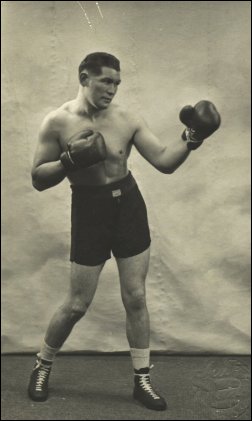
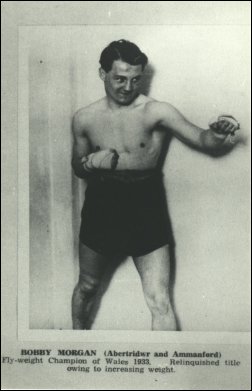
. were ChampionsBryn 'Ginger' Jones. Ferndale and Ammanford Sept '29 - '33 Featherweight Randy Jones Pontardulais Mar '33 - Jul '33 Light-Heavyweight Bobby Morgan Abertridwr and Ammanford. Jul '33 - '34 Flyweight Billy Quinlen Garnswllt May '32 - '34 Lightweight Danny Evans Ammanford July '32 - '34,
Apr '35
Welterweight
Middle (retired same year)Dai "Farmer" Jones Betws Feb '36 - '39 Middleweight Tommy Davies Cwmgorse July '43 - '52 Middleweight Reg Quinlen Garnswllt Nov '49 - '51 Lightweight Here are the other four Welsh Champions not in the above group photograph:
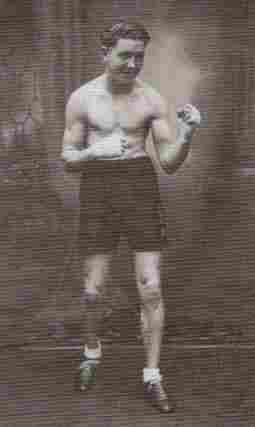
Tommy Davies, Welsh Middleweight champion (1943-1952) Bobby Morgan, Welsh Flyweight champion (1933-1934)
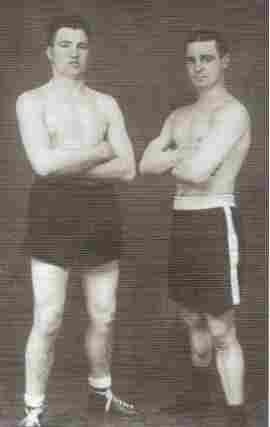
Dai 'Farmer' Jones ( left),
Welsh Middleweight champion (1936-1939)Reg Quinlen, younger brother of Billy Quinlen, Welsh Lightweight champion (1949-1951) Dai 'Farmer' Jones (see photo above)
Dai Jones, better known to the boxing fans as Dai "Farmer" Jones, was born in March 1914 on Llwynyronen farm at Betws, near Ammanford, West Wales. As a boy, he was very keen on physical culture and boxing. As the years went by, his love for boxing grew greater and his toughest fight was to persuade his parents to allow him to box. At the age of 20 years, Dai Jones turned professional, after only one amateur contest. He chose Johnny Vaughan of Ammanford as his manager and took seriously to boxing as his career.Drawing his first paid bout and losing the next, didn't seem such a good start but Dai won his next ten contests, and top of the list in his army of supporters were his parents, who were justly proud of their son. Chatting with Dai at his home, he recalled many of his outstanding bouts, and took the trouble to give me a complete list of his record. When you consider Dai was fighting in the days when almost every village in Wales boasted a well-known boxer, he did well to notch up fifty wins out of a total of eighty contests. Looking closely over his record you will find his losses were to top-notch names such as Jock McAvoy and Jack Hyams, who were fighters of the highest order. As most readers will know, Jock McAvoy was British and Empire middleweight, and British cruiserweight champion, who had knocked out world middleweight champion Babe Risko in less than a round in a non-title match.At least Dai only lost on points over ten rounds against the formidable McAvoy, which in itself is a feat of which he can be proud. In 1936, Dai outscored tough Glen Moody, but he was himself out pointed by Moody three years later when the Welsh cruiserweight title was at stake.Another point of interest: you will note Dai Jones lost several times to one Eddie Maguire of South Africa, although on one occasion he did get the better of Maguire. The very same Maguire was capable of beating and drawing with Freddie Mills, thus readers will fully appreciate the type of opposition Dai met during his fighting career. Number of Contests 80, Won 50, Lost 22, Drawn 8. (The above story © Tony Lee, Ammanford.)BOXING PRINTS FOR SALE
Prints of all the above photographs, along with many others, can be purchased from Tony Lee. Telephone: (01269) 591145).End of an Era
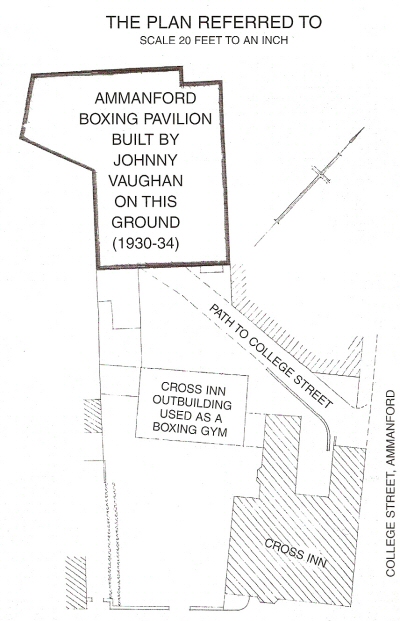
The gym of Johnny Vaughan was in an outhouse of the Cross Inn Hotel on Ammanford Square and boxing tournaments were held in the courtyard outside the Inn. Tournaments were initially held outdoors but in 1929 Johnny Vaughan erected a custom-built covered pavilion, costing £80, in the area behind the Cross Inn. It was a large timber frame and corrugated iron covered building, capable of seating several hundred paying spectators and, of course, the ring. The decision to build an indoor venue had been prompted by several wet and abandoned open-air tourments at the Cross Inn, whose abandonment had proved costly. Over the years several Welsh professional title fights were held at this venue.
During World War Two boxing almost stopped in Ammanford and the rest of Britain, although some fights were still arranged when Ammanford's boxers could get time off from working in the collieries. Coal mining was a reserved industry and miners were exempt from military duties. Even so, a general shortage of boxers from the rest of industry who were away on military service meant that tournaments were few and far between. Johnny Vaughan did organise some tournaments in Ammanford but they were for war-time charities and neither he nor the boxers who took part earned any money from these fights. As the leading historian on the Amman valley boxing scene in these years has written of Johnny Vaughan:
Johnny also had other things on his mind in 1944. The war had inevitably caused enormous disruption to sporting activities; no less in the Amman Valley than everywhere else. Johnny's boys, and their opponents, had gone to war and it was difficult for them to get leave to box. Those that remained were working flat out in the collieries and, when he could get a bill together at all, most of Johnny's promotions were now for charity. Furthermore, he had had to give up mining himself because by this time his lungs had been badly affected—he was eventually diagnosed with pneumoconiosis. It had become necessary for him to look at other ways of earning a living.
.....And so, on 6th June 1944, he and his wife Maud moved to the Mansel Arms in Llanelli, and he became a pub landlord. From here on, his diaries record the difficulties of getting beer deliveries, because it was in short supply, and the number of times he had to close early or open late. But he had chosen the premises with care. Above the bars was a large room entirely suitable for a gym, and it was here that Tommy Davies and the few remaining boxers under Johnny's management came to do at least part of their training.(Tony Lee, All in my Corner, 2009, page 283)
And the war more or less spelled the beginning of the end of the fairground boxing booths which had been the training ground for many professional boxers before 1939, Ammanford included. The brighly-lit fairgounds tradionally opened for business on summer evenings when people had finished work, but war-time blackout regulations meant that they could now only open during daylight hours, the time when people were working. Boxing booths in particular were hit by the fact that their young male customers, the 'all-comers' as well as the audience, not to mention the boxers, had gone off to fight in quite a different, and more deadly, conflict than boxing.
As a result the booths closed and while the fairgrounds re-opened at the end of war (and still operate today) a whole generation of potential booth boxers was lost, and fairground boxing booths have been lost forever. Many of the booth owners were already elderly when war broke out in 1939 and it was too hard a life to encourage their sons to take it up when hostilities ended in 1945. The absence of young blood was compounded when the booths were brought under regulatory control from 1947 onwards. In 1951, in discussion with the British Boxing Board of Control (BBBC), the Showmen's Guild published a series of conditions for the booth proprietors to adhere to. By the late 1950s the BBBC had ruled that no licensed fighters could fight competitive bouts in the ring other than exhibition rounds. It was the beginning of the end, although some booths survived as late as the 1970s. The boxing booth at Neath Fair was still in operation in the 1960s and booths at venues such as Nottingham Goose Fair, Durham Miners' Gala and others, survived into the 1970s.
A brutal trade, perhaps, whose loss few will bemoan, but the boxing booths were certainly a colourful part of of Welsh and British culture while they lasted, and the tents of booth promoters like Joe Gess and Jack Scarrott were a familiar and frequent sight in Ammanford and the Amman valley for two generations. In their heyday each region of the country would have three or four main booths travelling the fairground circuit with the boxers fighting for championships at both a regional and national level. Several of Ammanford's future professional boxers started their boxing careers in these booths, taking on all-comers and usually having several fights in the course of just a few hours. As well as these rough-and-tumble fights against local likely lads, often the worse for drink, formal bouts with purse money were staged at the booths, giving invaluable opportunity for young boxers to learn their trade.
One such boxer who started his career in the booths of Joe Gess was Tommy 'Kid' Farr from the Rhondda. Tommy Farr would go on the take world heavyweight champion Joe Louis to fifteen gruelling rounds in a now-legendary world title fight in New York in 1937, but before this he had countless fights in the booths of Joe Gess, including the Ammanford area.
After keeping the Mansell Arms public house in Llanelli from 1944, Johnny Vaughan returned to Ammanford in 1950 to live out the rest of his days, and where he continued to train and manager boxers until his retirement in 1953. It was in a room above the bars of the Mansell Arms that Johnny Vaughan kept a gymnasium to train the few boxers still under his management, and his Ammanford boxers had to travel to Llanelli to train with him. His two post-war Welsh champions were lightweight Reg Quinlen and middleweight Tommy Davies.
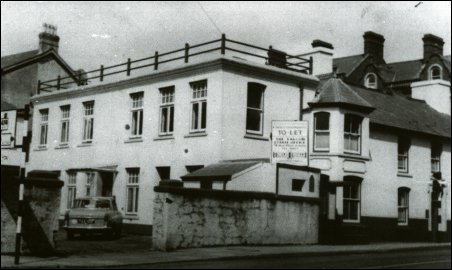
Johnny Vaughan died in 1964 in his home in Iscennen Road, co-incidently the year the Cross Inn was demolished. The elegant white-washed building had to make way for a sixties-style shopping complex, and a new public house called 'The Bard' replaced the Cross Inn. Here is what the Cross Inn looked like in 1964 just weeks before its demise. The "To Let" sign seems to be hinting that something is coming to an end. An era, perhaps.
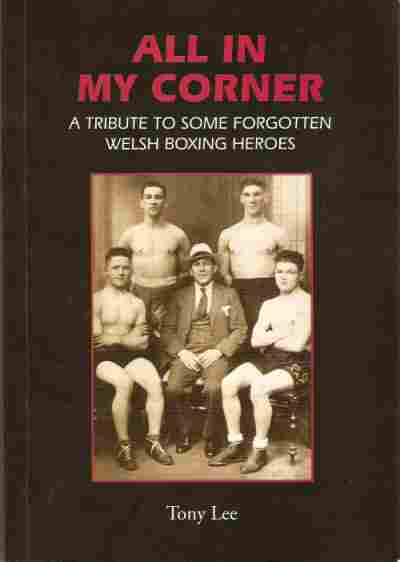
BOXING BOOK: ALL IN MY CORNER by Tony Lee
In December 2009 a much-awaited book on the history of boxing in the Amman valley was published which is an invaulable read for the history of the sport in the valley but with much other history included between its covers. All In my Corner, at 310 pages plus index, is researched and written by Ammanford boxing historian and journalist Tony Lee and can be purchased by contacting Tony Lee on (01269) 591145. Price: (paperback) £10.99 plus £2 post and package ); (hardback) £14.99 plus £2.45 post and package.
All In my Corner at 310 pages plus index is a detailed history of boxing and boxers from the Amman valley, researched and written by Ammanford boxing historian and journalist Tony Lee. It can be purchased by contacting Tony Lee on (01269) 591145). BOXING LINK
There is an excellent website devoted to Welsh boxers, past and present, famous and obscure on: www.johnnyowen.com. The fight records of the above and other boxers can also be found on this site. The site also contains links to other boxing websites, including current rankings and title holders and lists of world champions down the ages.BOXING BOOTH LINK
The website of the National Fairground Archive is a wealth of information on fairgrounds and their associated boxing booths. For more on the historiy of the booths, click HERE.Acknowledgments:
Thanks to Tony Lee of Ammanford who supplied all the above photographs and information about the boxers.Click for a brief history of the Amman Valley Amateur Boxing Club.
Date this page last updated: August 31, 2010